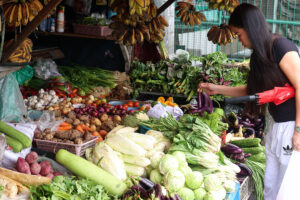
For those of us who are vegetable eaters, we may be conscious about the price of upland vegetables, like chop suey ingredients (carrots, sayote, Baguio pechay or wombok and beans), which generally come from Baguio if you are in Manila, and Bansalan if you are from Davao City. You should also consider the prices of upland salad ingredients like lettuce, tomatoes and onions.
For lowland vegetables or a pinakbet mix, we have squash, pole beans (sitaw), okra, ampalaya and kangkong. These may come from Laguna and other parts of Luzon. But did you know that there may be as much as 12 points to pass before the vegetable reaches your plate?
Because of these 12 touchpoints, 40% of the produce actually wilt or get damaged and, eventually, the second-to-the-last touchpoint may have a recovery of only 60-70% of the initial truckload. Thus, vegetables have already become very expensive upon reaching their destination. One reason is perishability, and another is the multiple stations they have to pass to get to the consumer.
You may think it is simply a supply chain issue. It probably is more complicated than that.
1. Farmers have no financial capacity to buy seeds and fertilizers so they borrow. They don’t have credit history so they borrow from their buyers, like an advance contract.
2. Buyers have the farmers in the palm of their hands because they have extended credit to the producer.
3. Farmers plant the same crops because they don’t know who their final buyer will be, so they join the bandwagon who have buyers in bagsakan or depots.
4. Once they get their money, they pay their loans to the buyers and then zero out and start again. That is a vicious cycle that many farmers experience.
I recently met a group that probably has a solution to this recurring problem. They combined technology and farming knowledge to introduce apps and the use of social media, like Facebook, to talk to farmers and buy their produce. To date, they have helped over 38,000 farmers who can now benefit from direct trade, or at least a four-step process better than the usual 12-step way.
They establish hubs and become the alternative bagsakan or depot and farmers bring their goods to these alternative hubs, instead of the usual public depot. They get better prices and they also are seen by the operators in the flesh, no longer invisible to the wholesale buyer or aggregator. The aggregators call themselves AgroDigital PH and they revolutionized buying of perishable produce, like your pechay or lettuce. They have B2B customers, like a supermarket chain that also has locations around Luzon, for example.
Founders Henry James Sison and Analissa Jardin joined us at a Slow Food event at a culinary school to explain their business concept, which is truly admirable.
Another innovator is Lakal, Inc. — started by Reuben Ravago and Rhoderick “Heaven” Torres — which is also using a model that may revolutionize buying and selling of coffee and other commodities. Lakal will establish hubs, but the difference is that they will store commodities, like coffee and corn, and be the intermediary between buyer and seller. With commodities that can be stored longer (unlike vegetables that are highly perishable), you can wait a few weeks or months for better prices before making a transaction.
Lakal has rules on buying and selling and may be the solution to price fluctuations that subject the farmers to shock and disappointment. Buyer and seller must agree on the price (called farmgate) before the transaction succeeds with Ravago as the intermediary. Again, this will use technology to determine available stocks and market prices, and brokering a sale will be transparent. This is patterned after the Chicago Mercantile Exchange and will soon be launched to help commodity farmers and producers.
Agro Digital PH and Lakal are just two examples of innovative tools, apps and ideas that could help our farmers navigate the supply chain challenges because our country is archipelagic, and cold storage is hard to come by for the common farmer.
I also heard of horror stories of hoarders establishing cold storage facilities, buying all the onions at super low prices, keeping them and waiting for a shortage so they can unleash their inventory at super-high prices. There ought to be a law against these economic saboteurs. Such has been the story of the Philippines for many years now. People with money just cannot moderate or manage their greed, and make fast money because they have the capital to begin with, much to the dismay of the disgruntled food producer.
With technology and people like Ravago and Sison, we hope that things will change albeit slowly but surely. Technology, social consciousness and good values may just save the day.
We salute these technopreneurs, who may be the Department of Agriculture’s allies in making sure our farmers are paid well, can live decently and will be sustainable as SMEs that give us our food.
The next time you buy vegetables, think of where they came from. We need to support the new generation of entrepreneurs who will secure our food supply through technology, so we can have more farmer-entrepreneurs empowered by Sison using technology. And we may have a real commodity exchange using the tools created by Ravago’s group.
These are welcome developments in the area of food security, and we hope that consumers support these innovations, so we do not lose our farmer population and just turn to imports.
Technology and Agriculture — their marriage is key to our food security.
Chit U. Juan is co-vice-chair of the Management Association of the Philippines’ Environment Committee. She is also the president of the Philippine Coffee Board, Inc. and Slow Food Manila (www.slowfood.com).