For most of the past three years, the AI investment story has been simple. Build the biggest model, train it on the most data, and the market rewards you.
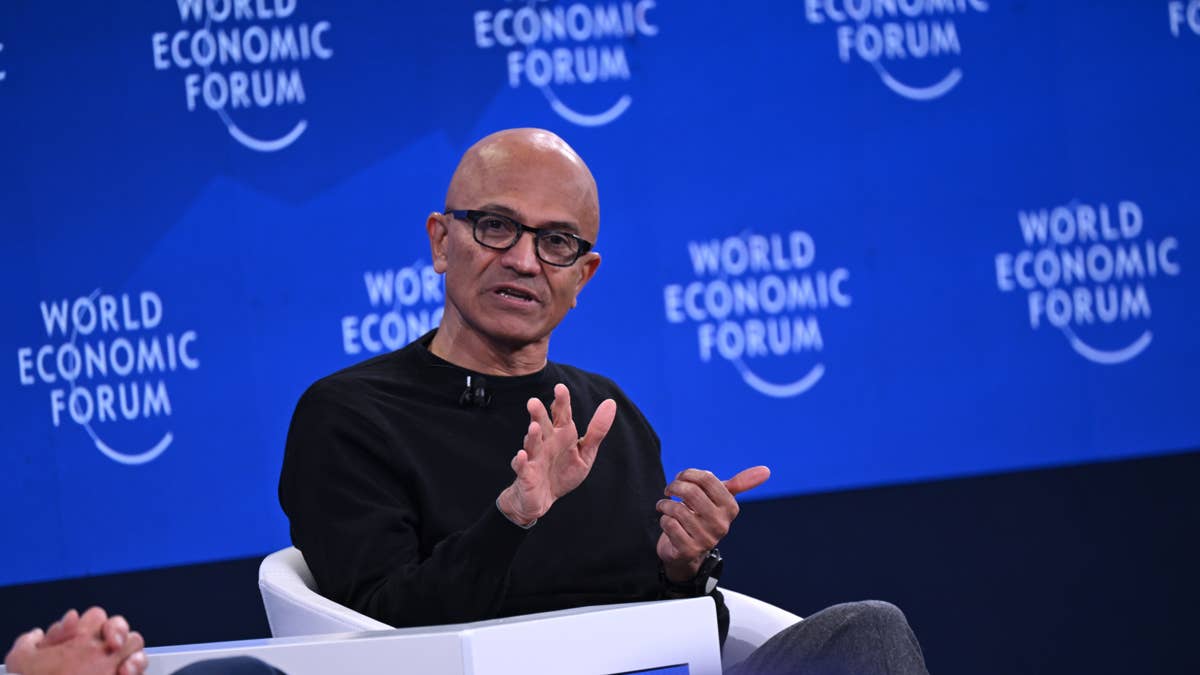
On June 14, Microsoft CEO Satya Nadellapublished a lengthy post arguing that story is about to change, and that investors who keep following it could end up backing the wrong companies entirely.
His argument is not that AI is moving too slowly. It is that the industry may be building toward an outcome that, in his own words, “the political economy will simply not tolerate.”
The two kinds of capital Nadella says every company will need
Nadella’s central framework splits corporate value into two categories. The first is human capital, the knowledge, judgment, relationships, and pattern recognition that employees bring. The second is what he calls “token capital,” the proprietary AI systems a company builds and owns on top of foundation models.
“Human capital does not become less valuable as token capital grows. It only becomes more valuable,” Nadella wrote.
That framing pushes directly against a narrative that has gained traction over the past year, the idea that AI capability and human expertise are substitutes for each other, where more of one means less need for the other.
Why Nadella thinks commoditization is the real risk
The warning at the center of the post is about concentration, not capability. Nadella’s concern is that if a small number of foundation models capture most of the economic value AI generates, companies across every industry could lose the proprietary knowledge that currently differentiates them from competitors.
More AI:
- Micron sits at the center of a red-hot chip rally
- IBM CEO sends blunt message on AI and quantum computing
- Anthropic CEO makes shocking admission about AI
“The last thing any of us want is a world where every company across every sector is ceding value to a few models that eat everything they see,” he wrote. “If all the value is accrued by only a few models, the political economy will simply not tolerate it. There is no societal permission for an AI future that hollows out entire industries.”
That last line is doing more work than it might appear to at first.
Nadella is not just describing a business risk to individual companies. He is describing a scenario where the backlash to AI concentration becomes a political problem large enough to invite the kind of regulatory response that reshapes the industry’s economics for everyone, including the foundation model companies themselves.
The globalization comparison Nadella is drawing on purpose
To make his point concrete, Nadella reached for a comparison from outside the technology sector entirely.
“Think about what happened in the first phase of globalization where entire industrial economies were hollowed out by outsourcing,” he wrote. “The GDP numbers looked fine on the surface, but the displacement was real and the consequences are still being felt.”
The comparison is deliberate. Aggregate productivity and GDP growth from AI could look strong even if the gains are concentrated among a handful of companies, while the displacement of expertise across other industries goes largely unmeasured until it becomes a political issue. Nadella is arguing that AI’s aggregate numbers could tell the same misleadingly reassuring story that globalization’s did, right up until the point where they stop being reassuring.
Ozalp/Getty Images
What this means for how Microsoft positions itself
The post also doubles as a positioning statement for Microsoft (MSFT) itself. Unlike AI labs that compete primarily on building the most capable foundation model, Microsoft has built its AI strategy around platforms, developer tools, and enterprise infrastructure that sit on top of those models.
Nadella argues that companies should be able to swap out the underlying “generalist” model without losing what he calls the “company veteran” expertise embedded in their own systems.
He describes this as a test of a company’s “control and sovereignty” in an AI-driven economy. For Microsoft, building the tools that let enterprises run that kind of model-agnostic system is itself a business, one that does not require Microsoft to win the race for the single most powerful model.
How this fits Nadella’s recent pattern of public commentary:
- This is not the first time Nadella has used a public platform to challenge how the AI industry frames its own progress. At Davos in January, he warned the Fortune 500 that AI growth driven purely by investment, rather than productivity gains, would be a telltale sign of a bubble, and argued companies would need to restructure how information flows through their organizations to capture real value from AI.
- At Davos in January, Nadella told a separate audience that AI deployment globally would be constrained primarily by access to capital and energy infrastructure rather than by model capability itself, according to Euronews, a comment that fits the same broader theme of looking past the model layer to what surrounds it.
- The “learning loop” concept Nadella describes, where private evaluations and reinforcement learning on a company’s own data compound over time, is effectively an argument for why enterprise AI spending should be viewed as a long-term capital investment in proprietary infrastructure, not a recurring subscription cost to a model provider.
- Coming so soon after a separate controversy involving a different major AI lab’s models being pulled under a government directive, Nadella’s emphasis on “control and sovereignty” over which models a company depends on reads, intentionally or not, as a hedge against exactly that kind of disruption happening to any single model provider.
The question this raises for AI investors
If Nadella is right, the framework many investors have been using to value AI companies, ranking them by model capability and benchmark performance, may be measuring the wrong thing.
The more durable advantage, in his telling, belongs to whichever companies build the “learning loop” that lets human expertise and AI capability compound together inside an organization.
That does not mean foundation models stop mattering. It means the companies that win may not be the ones with the best model in any given quarter, but the ones that have made it easiest for other companies to build proprietary systems on top of whatever model is best at the time.
Nadella’s own post is, in effect, an argument for why that second category of company, the one Microsoft has spent years building itself into, may end up capturing more durable value than the first.
Related: Microsoft CEO sends another shocking message to employees