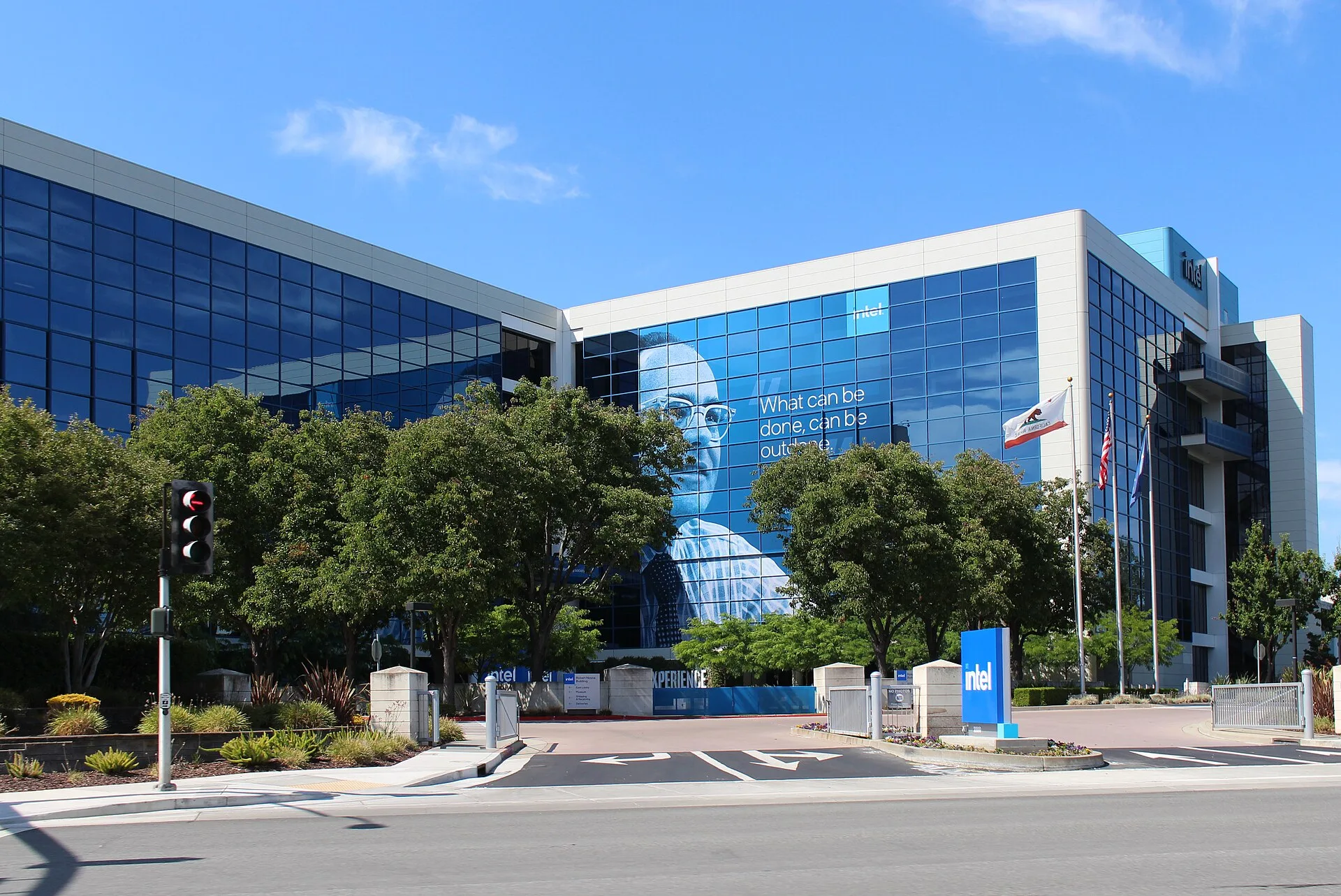
Intel’s two biggest numbers of 2026 both run backwards from intuition, and that is the most useful thing to understand before touching the stock. Intel (NASDAQ: INTC) closed at $87.48 on 25 August 2026, up roughly 259% over twelve months but about 39% below the $142.35 high it set in July. In the second quarter it reported a GAAP net loss of $11.0 billion — on revenue that grew 25%, its fastest in more than fifteen years. And in August it raised roughly $23 billion of equity at $95 a share, a price the stock no longer holds. Our Intel stock prediction runs to a $135 bull case and a $48 bear case, and neither depends on the foundry roadmap arriving on time.
Start with the loss, because almost every summary of it is wrong. The $11.0 billion GAAP loss was driven by a $13.6 billion non-cash mark-to-market charge on “Escrowed Shares” — Intel stock held in escrow for release to the US Department of Commerce under the CHIPS Act Secure Enclave agreement, recognised as a derivative liability under Intel’s Warrant and Common Stock Agreement with the US Government. Because that liability is denominated in Intel’s own shares and carried at fair value, it gets larger when the stock goes up. Intel’s worst reported loss in years is, mechanically, a consequence of its share price tripling. Strip the charge out and the same quarter produced $2.2 billion of non-GAAP net income and $7.0 billion of cash from operations. The loss is real accounting, but it is not a cash cost, and it is not evidence the business is deteriorating. It is evidence the government’s stake became more valuable.
Key facts
- Share price: $87.48 at the close on 25 August 2026; 52-week range $23.68 to $142.35 — stockanalysis.com, 25 August 2026
- Q2 2026 revenue: $16.1 billion, up 25% year over year, described by CEO Lip-Bu Tan as the strongest revenue growth in more than fifteen years — Intel Q2 2026 earnings release, 23 July 2026
- The loss: GAAP EPS $(2.16) and a net loss of $11.0 billion, against non-GAAP EPS of $0.42 and non-GAAP net income of $2.2 billion — Intel Q2 2026 release
- The cause: $13.6 billion mark-to-market charge on Escrowed Shares owed to the US Department of Commerce — Intel Q2 2026 release, cash-flow reconciliation
- Margins recovered sharply: GAAP gross margin 40.4% against 27.5%, GAAP operating margin 11.1% against negative 24.7% a year earlier — Intel Q2 2026 release
- The raise: upsized from $15 billion to $20 billion, priced at 210,526,315 shares at $95.00 on 10 August, with a 31,578,947-share option exercised in full on 11 August — Intel Form 8-K, 12 August 2026
- Existing leverage: $48.5 billion of debt against $12.9 billion cash and $16.9 billion short-term investments at 27 June 2026 — Intel Q2 2026 release
The quarter Intel actually had
Underneath the accounting, Q2 was the most convincing operational quarter Intel has produced in years. Revenue of $16.1 billion grew 25%. GAAP gross margin recovered to 40.4% from 27.5%. GAAP operating margin swung from negative 24.7% to positive 11.1%, a 35.8-point improvement. Non-GAAP operating margin reached 17.2%.
“AI is driving unprecedented demand for compute, and as we continue to execute, Intel is well-positioned to capture sustainable growth across our CPU franchise, ASICs, advanced packaging and vast wafer foundry network,” said Lip-Bu Tan, Intel’s chief executive. Chief financial officer Dave Zinsner attributed the beat to “robust demand and improved execution, including volume upside driven by higher factory yields and improved cycle times,” and flagged that Intel is “meaningfully increasing our investments in equipment, clean room space, and substrates.”
That last clause is the bridge to the equity raise. Higher yields and better cycle times are exactly what a foundry needs before it spends, and Zinsner said plainly that spending is going up.
Two caveats belong here. First, year-over-year comparability is affected by the deconsolidation of Altera, so the 25% figure is not a pure like-for-like. Second, guidance is more modest than the quarter: Q3 revenue of $15.8 billion to $16.8 billion, with EPS of $0.31 GAAP and $0.38 non-GAAP. On a roughly $1.60 annualised non-GAAP run rate, Intel trades near 55 times earnings at $87.48 — a demanding multiple for a company still rebuilding.
The raise, and why it had to be equity
On 10 August Intel priced 210,526,315 shares at $95.00, upsizing a deal it had announced two days earlier at $15 billion. The underwriters’ 31,578,947-share option was exercised in full the following day. Gross proceeds land near $23 billion, against roughly 5.04 billion shares outstanding — dilution of about 4.8%. Stated use of proceeds is general corporate purposes, which “may include capital expenditures and working capital.”
The interesting question is not why Intel wanted the money. It is why it sold shares rather than bonds. The answer sits on the balance sheet: Intel already carries $48.5 billion of debt. For comparison, AMD’s total debt principal was $3.25 billion before its own August financing, which is why AMD could comfortably raise $4.75 billion in senior notes while Intel diluted its shareholders instead. Same capital cycle, opposite instruments, dictated by how much room each balance sheet had left.
It is worth being fair about the pricing. The $95 level was struck at a modest discount to Intel’s $97.52 close on 10 August, which is normal for a marketed deal of this size, and the stock traded up to $104.56 by 13 August. The market absorbed $23 billion of new paper without breaking. What happened next is the problem: the shares have since fallen about 16% from that post-deal peak to $87.48, leaving the offering roughly 7.9% underwater and buyers of the deal down in the region of $1.8 billion on paper. That is not a verdict on the pricing. It is a verdict on how quickly sentiment toward the whole AI-infrastructure complex has cooled in two weeks.
What the government stake really does
The US government holds an equity interest of roughly 10% in Intel, and Intel’s own risk factors now list “the U.S. government’s acquisition of significant equity interests in us” among its stated risks. The escrowed-share mechanism means a portion of that stake is released to the Department of Commerce as Intel performs and receives cash under the Secure Enclave agreement.
For investors the practical consequences are three. First, GAAP earnings are now partly a function of Intel’s own share price, in the wrong direction — every rally enlarges the liability and depresses reported profit, which will keep producing headlines that misread as operational deterioration. Second, non-GAAP is the more informative measure for this specific company at this specific moment, which is an uncomfortable thing to have to say. Third, Intel has a shareholder whose objectives are industrial policy rather than return on capital, and whose presence is a floor under the equity in a crisis and a constraint on strategic flexibility the rest of the time.
Intel is not alone in having a strategically motivated holder: Nvidia is reported to hold roughly $30 billion of Intel shares. Between a sovereign stake and a stake held by the company Intel is trying to compete with in accelerators, the register is unusually political for a large-cap semiconductor.
The valuation
| Scenario | Target | Implied maths | What has to be true |
|---|---|---|---|
| Bull | $135 | ~30x estimated 2028 non-GAAP EPS of roughly $4.50 | 18A and 14A yields hold, external foundry customers sign at volume, the $23bn converts into capacity that earns a return, and margins keep climbing toward the mid-40s |
| Base | ~$95 | Roughly the level at which the market was willing to fund the company three weeks ago | Execution continues, foundry progresses without a marquee external win, multiple stays elevated on strategic scarcity |
| Bear | $48 | ~25x estimated 2027 non-GAAP EPS of about $1.90 | Foundry customer wins stay slow, capex keeps rising, the raise proves to be the first of several, and the multiple normalises toward what a 15%-operating-margin manufacturer usually earns |
At $87.48 on roughly $1.60 of annualised non-GAAP EPS, Intel is priced at about 55 times — meaningfully more expensive on current earnings than either AMD or Dell, which is counterintuitive for the company with the weakest recent record. The market is not paying for Intel’s earnings. It is paying for optionality on a US-based leading-edge foundry succeeding, plus the implicit support of a sovereign shareholder. That is a legitimate thing to pay for, but it should be named for what it is, because it is what makes the bear case so wide.
The asymmetry cuts both ways. A move to $48 would take Intel back to roughly where it traded in March 2026, which was not a distressed level at the time. A move to $135 would still leave it below the July high. Neither end of the range requires anything dramatic.
The tension: industrial policy versus shareholder returns
Intel is now the clearest case in the market of a company whose strategy is partly set by policy. The CHIPS Act funding, the Secure Enclave agreement and the government equity stake all point the same direction: build leading-edge capacity on US soil, at a scale and pace the free market alone would not fund. That is why the raise happened, and it is why Intel’s capital spending will stay elevated regardless of quarterly demand.
Shareholders benefit from the subsidy and pay for the mandate. The subsidy is cheap capital and a buyer of last resort. The mandate is capex that must proceed on a political timetable, a share count that grows to fund it, and reported earnings distorted by an instrument written in the company’s own stock. Investors also carry the input-cost pressure running through the whole sector, which FinanceFeeds covered when TSMC raised chip prices by up to 10% — though Intel is unusual in being both a payer of foundry prices and a would-be setter of them.
What happens next
Intel reports Q3 2026 in late October. Three things will decide which scenario is running.
First, a named external foundry customer at volume. This is the single highest-value disclosure available to Intel and the load-bearing element of the bull case. Absent it, the foundry thesis stays a promise.
Second, capex guidance. Zinsner has already said investment in equipment, clean rooms and substrates is increasing. If the 2027 capex number implies the $23 billion is a down payment rather than the funding round, expect the market to price further dilution immediately.
Third, the escrowed-share charge. If Intel’s stock recovers, the charge grows again and GAAP will show another large loss. Read the non-GAAP line and the cash-flow statement first; the GAAP headline for this company currently tells you more about the share price than about the business.
Our base expectation is that Intel meets guidance and that the stock is driven by foundry news rather than by the income statement. Anyone weighing exposure across the AI-compute stack may want to read this alongside our Nvidia stock prediction, since Intel is the only one of these names whose upside depends on winning business from the others.
Frequently asked questions
Why did Intel report an $11 billion loss on record revenue growth?
The loss was driven by a $13.6 billion non-cash mark-to-market charge on Escrowed Shares owed to the US Department of Commerce under the CHIPS Act Secure Enclave agreement. Because the liability is measured in Intel’s own stock at fair value, it increases when the share price rises. Excluding it, Intel earned $2.2 billion of non-GAAP net income and generated $7.0 billion of cash from operations.
What is a realistic Intel stock prediction for the next 12 months?
Our bull case is $135, roughly 30 times estimated 2028 non-GAAP EPS of about $4.50, and our bear case is $48, roughly 25 times estimated 2027 non-GAAP EPS of about $1.90. At $87.48 Intel trades near 55 times its current annualised non-GAAP run rate, so the multiple, not the earnings, is what moves the outcome.
How much did Intel raise in its August 2026 stock offering?
Intel priced 210,526,315 shares at $95.00 on 10 August 2026, upsized from an initially announced $15 billion to $20 billion, and the underwriters exercised an option for a further 31,578,947 shares in full on 11 August. Gross proceeds are near $23 billion, representing roughly 4.8% dilution against about 5.04 billion shares outstanding.
Is Intel stock below the price of its own share offering?
Yes. The offering was priced at $95.00 and the shares closed at $87.48 on 25 August 2026, about 7.9% lower. The stock had traded as high as $104.56 on 13 August before falling back, so the shortfall reflects a broad cooling in AI-infrastructure sentiment rather than a failed deal.
What does the US government stake mean for Intel shareholders?
The government holds roughly 10% of Intel, and Intel lists the stake among its risk factors. It provides political support and access to CHIPS Act funding, but it also ties capital spending to an industrial-policy timetable and introduces the escrowed-share accounting that distorts GAAP earnings. Non-GAAP measures and cash flow are currently the more informative figures.
Why did Intel sell equity when AMD sold debt?
Balance-sheet capacity. Intel already carries $48.5 billion of debt, while AMD’s total debt principal was $3.25 billion before its own August financing. Intel had far less room to add leverage, so it diluted shareholders instead of borrowing.
This article is editorial analysis and information, not investment advice. Bull and bear cases are FinanceFeeds estimates derived from company filings and are not Intel guidance. Earnings estimates beyond company-issued guidance are our own. Figures were verified against primary sources as of 26 August 2026; readers should verify current prices before acting.