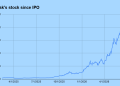

Intel spent years struggling to regain its technology edge as investors fretted about lost market share, manufacturing problems, and eroding profitability.
Now the company faces a very different problem.
Maybe it got too few chips.
Intel (INTC) shares surged 9.1% to $104.47 on Sept. 8, even as the broader market declined, after DigiTimes reported that Intel is preparing to raise prices on PC processors by another 10% in October. Intel could also discontinue lower-margin Small Core products.
The reported increase would be the latest in a string of price moves since late 2025, including an approximately 10% hike in the first quarter. Intel has not confirmed the latest reported move.
A 10% price hike normally wouldn’t get this sort of excitement in a semiconductor stock.
But Intel’s own filings explain why investors are paying attention.
Its server products saw average selling prices surge 48% year over year last quarter, while server volume rose 9%. Demand has exceeded available supply, Intel said.
That suggests the latest price increase is potentially less about passing along costs and more about something Wall Street has been waiting years to see from Intel: pricing power.
Intel is charging more even as the PC market stays weak
The surprise about Intel’s situation is the absence of a growth in conventional PC demand.
RBC Capital Markets analyst Srini Pajjuri described PC and smartphone demand as “weak but stable.” Laptop output has been below average levels, while demand for desktop computers seems especially poor.
But Intel has already proved it can charge greater pricing.
Client computing revenue in the second quarter was $7.7 billion, up $1.1 billion year-over-year. Average selling prices rose 27%, more than making up for an 8% fall in unit volume.
Intel said that most of the rise came from consumers purchasing a better mix of premium items, although price hikes driven by demand also helped.
The reported October rise would carry that plan even farther.
DigiTimes also said that Intel may kill its low-margin Small Core products as CEO Lip-Bu Tan focuses on boosting profitability rather than chasing sales.
Related: Intel’s secondary share sale explained
That would signify a major strategic shift.
Intel has spent years battling to retain market dominance against Advanced Micro Devices and the growing threat of Arm-based chips.
But the new plan seems to be the opposite: offer fewer low-margin items, focus on limited production capacity, and charge more where demand exists.
AI has created a much bigger opportunity for Intel
The true price story is unfolding within data centers.
Intel’s Data Center and AI division saw a $2 billion year-over-year boost in server sales in the second quarter. Server unit volumes were up 9%, and average selling prices were up 48%.
A higher-end product mix, supplemented by demand-based pricing, mostly drove the rise.
More crucially, Intel indicated that server demand outpaced its available supply due to internal restrictions. The business is also boosting plant capacity but anticipates larger industry supply limitations to remain throughout next year.
MarketWatch says that the amount of Intel x86 server CPUs is projected to rise between 15% and 20% as vendors struggle to fulfill demand driven in part by agentic AI and inference.
That leaves Intel in a difficult position during the AI boom.
GPUs remain paired with CPUs for general-purpose computing within data centers; Nvidia (NVDA) dominates AI accelerators. As inference workloads increase, demand might spill over from GPUs onto servers, networking, memory, and conventional CPUs.
Intel doesn’t need to dethrone Nvidia for its AI business to see a massive improvement.
It only needs the AI infrastructure buildout to keep gobbling up more compute.
Intel’s 183% rally raises the stakes
The shift hasn’t gone unnoticed by investors.
Intel shares are up approximately 183% in 2026 thus far, making a long-running recovery tale one among the year’s largest semiconductor rallies.
More Intel:
- 5-star analyst aggressively resets Intel stock price target after earnings
- Goldman delivers a candid response after Intel’s stunning quarter
- Intel makes another painful move in one of its key businesses
Part of that confidence is based on the company’s most recent financial reports.
Intel’s second-quarter revenue rose 25% to $16.1 billion, its best growth in 15 years. Third-quarter revenue was guided to $15.8 billion to $16.8 billion and operating cash flow was $7 billion.
Intel’s biggest weakness may have become an advantage
But there’s a hitch.
Higher prices don’t automatically translate into higher profits when Intel itself is facing higher input costs.
The memory is the worst. RBC’s supply-chain investigations show high-bandwidth memory prices might surge by 80% to 100% next year, while wider DRAM shortages are pushing component costs higher throughout the industry.
Intel is likewise in the midst of a costly production turnaround, and its 183% stock rise provides far less space for performance missteps.
But the second-order alteration is not difficult to overlook.
The challenge for Intel in the past was that rivals were stealing share and the company was struggling to get premium pricing.
Now customers are paying more.
Client processor ASPs were up 27%. Server costs surged 48 percent. Server volumes went up despite those higher charges. Intel says demand has outstripped available supplies.
That’s why Wall Street reacted so violently to what seems on the surface like a modest 10% price hike.
The key figure is not ten percent.
It’s 48%.
Intel’s AI turnaround may be providing the corporation with something perhaps more important than market share: the ability to tell consumers its chips cost more, yet still have more demand than it can supply.
Related: Intel’s stock buybacks: History & investor impact explained