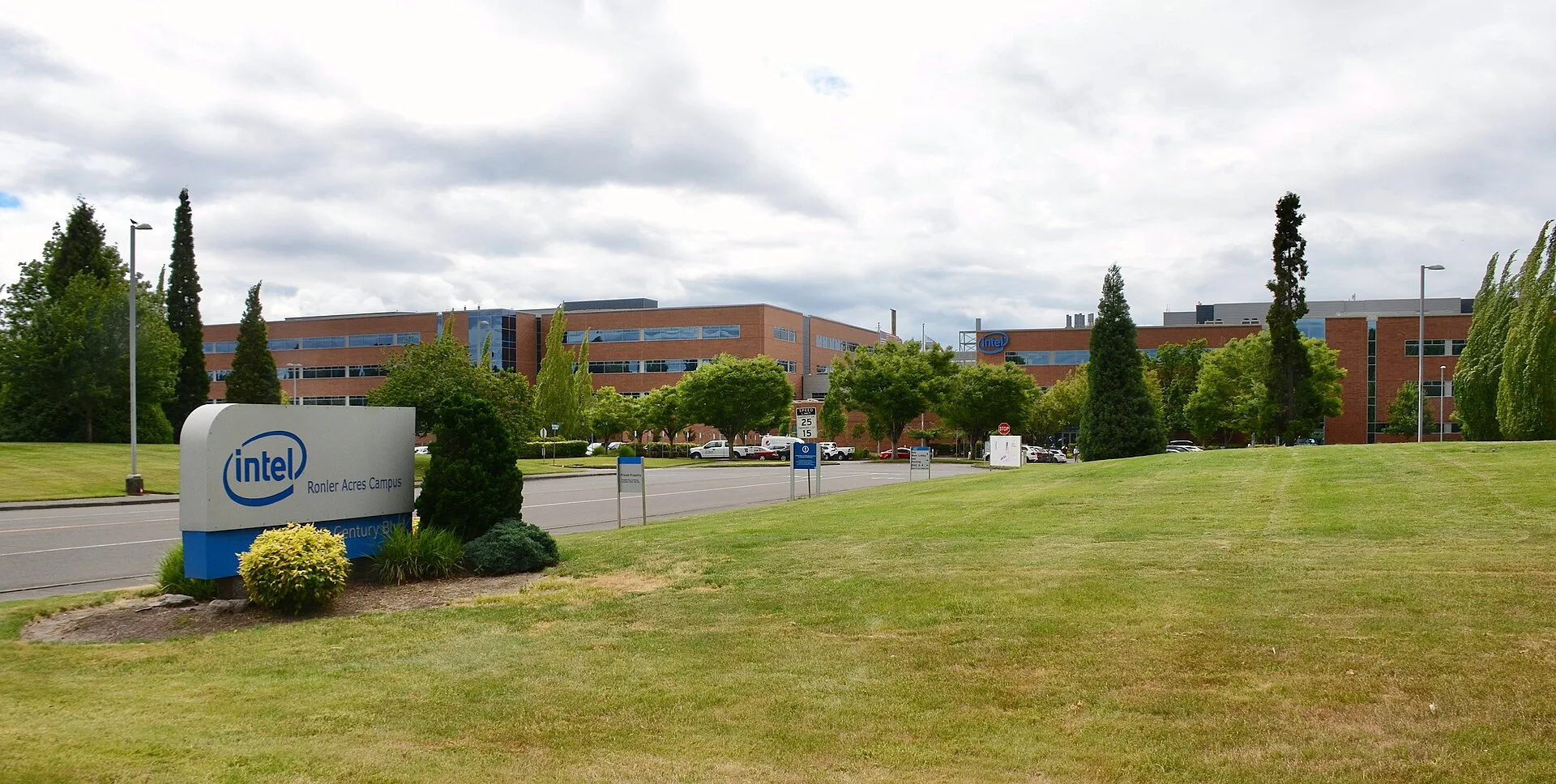
The most common thing said about Intel in 2026 is that the turnaround is finally showing up in the numbers. It is not, at least not in the number that matters most. Intel’s second quarter carried a GAAP net loss of $11.0 billion against $2.2 billion of non-GAAP net income, and almost the entire $13.2 billion gap is one line: a $12.5 billion mark-to-market loss on shares Intel owes the US government. That liability gets bigger every time the stock goes up. Intel is, in the most literal accounting sense available, structurally short its own equity — and at $123.00 after a 212% year-to-date run, that is the single most under-discussed fact in the INTC bull case.
Here is the part no one is putting a number on. Intel’s own Form 10-Q for the quarter ended 27 June 2026 discloses 143 million Escrowed Shares not yet released to the Department of Commerce. Mark those to market and every $10 move in INTC swings roughly $1.43 billion through the income statement — about $143 million per dollar. The derivative liability stood at $15.6 billion at quarter end, up from $2.7 billion in December 2025. That is the mechanism that turned a genuinely strong operating quarter into a headline disaster, and it is also the mechanism that will quietly flatter Q3, because Intel’s shares fell during the September quarter. Nobody is modelling the reversal.
Key facts
- INTC closed at $123.00 on 25 September 2026, down 3.45% on the day from $127.39 — stockanalysis.com daily closes
- Up 212.3% year to date and 261.9% over twelve months, against a 52-week range of $31.21 to $142.35 — FinanceFeeds calculation from daily closes
- Q2 2026 revenue $16.1 billion, up 25% year on year — Intel Q2 2026 results, 23 July 2026
- Q2 GAAP EPS -$2.16 versus non-GAAP EPS $0.42 — Intel Q2 2026 results
- $12.529 billion mark-to-market loss on Escrowed Shares in Q2 alone, equal to $2.45 per share — Intel Form 10-Q, 27 June 2026
- Adjusted free cash flow of -$8.419 billion in Q2, versus -$1.050 billion a year earlier — Intel Q2 2026 results
- Intel Foundry revenue $5.8 billion, up 31%; Data Center and AI $6.3 billion, up 59% — Intel Q2 2026 results
What is actually happening at Intel, and why
Strip out the escrowed-share noise and Intel’s operating business had its best quarter in a decade and a half. Per Intel’s Q2 2026 results filed with the SEC, revenue of $16.1 billion was up 25% year on year. Gross margin went from 27.5% to 40.4% on a GAAP basis, a 12.9 percentage point swing. Operating margin moved from negative 24.7% to positive 11.1%. The company generated $7.0 billion in cash from operations.
The mix tells you where it came from. Data Center and AI revenue rose 59% to $6.3 billion — the fastest-growing unit by some distance, and the one that matters for the AI narrative. Client Computing and Physical AI grew a more pedestrian 13% to $8.9 billion. Intel Foundry booked $5.8 billion, up 31%, though the large majority of that is still Intel manufacturing chips for Intel; intersegment eliminations of $5.5 billion tell you how much.
The technology roadmap is the part that has genuinely moved. Intel launched Xeon 6+, its first server-class product built on Intel 18A, and 18A-P entered risk production on the timeline Intel gave customers a year earlier — an unfamiliar sentence to write about this company. Panther Lake entered high-volume manufacturing using ASML’s High-NA EUV tooling. Think of a process node the way you would think of a printing press: for a decade Intel owned the best press in the world and then let it fall two generations behind, which is why it lost customers it had never had to compete for. 18A is the first press that is arguably competitive again, and the first one Intel has offered to strangers.
“AI is driving unprecedented demand for compute, and as we continue to execute, Intel is well-positioned to capture sustainable growth across our CPU franchise, ASICs, advanced packaging and vast wafer foundry network,” said Lip-Bu Tan, Intel’s chief executive, adding that the quarter “represent[s] our strongest revenue growth in more than fifteen years.” For a company that spent 2026 shedding staff — we covered the 39,700-person headcount reduction and the severance arithmetic behind it — that is a material change of tone.
The government share overhang nobody prices
Now the part that competing coverage keeps filing under “one-off.” It is not a one-off. It is a recurring, mechanical, price-linked charge, and the filing spells out exactly how it works.
Under the US Government Agreement signed with the Department of Commerce on 22 August 2025, Intel issued shares into escrow, to be released to the DOC as Intel performs under and receives cash proceeds from its CHIPS Act Secure Enclave agreement. Intel accounts for those shares as a derivative liability measured at fair value, with changes running through interest and other, net. In plain terms: Intel owes somebody a fixed number of its own shares, and the more valuable those shares become, the larger the debt.
The numbers from the 10-Q, verbatim in substance:
- Escrowed Shares derivative liability: $15.6 billion at 27 June 2026, versus $2.7 billion at 27 December 2025
- Mark-to-market losses: $12.5 billion in Q2 2026, $13.6 billion in the first half
- Shares released: 7 million in Q2, 13 million in the half
- Shares still in escrow: 143 million, of which 71 million are treated as not contingently issuable and 71 million as contingently issuable
There is a detail in the definitions section that deserves more attention than it has had. If the Escrowed Shares are not released by the end of the performance period, half go to the DOC for no consideration and half are forfeited and cancelled. So the downside scenario for Intel’s operational performance is, perversely, a partial win for shareholders on dilution — and the upside scenario is full delivery of 143 million shares, roughly 2.8% of the current count.
Here is the forecast that follows, and it is falsifiable. Intel’s fiscal Q2 ended on 27 June, with the last close before it at $128.32. Its fiscal Q3 ended on 26 September, with the last close at $123.00. The stock fell about 4.1% across the quarter. Applied to 143 million escrowed shares, that implies a mark-to-market gain of roughly $0.76 billion in Q3 — a reversal of sign on the single largest line in the GAAP bridge. Intel’s own guidance is consistent with it: management guided Q3 GAAP EPS of $0.31 against non-GAAP EPS of $0.38, a seven-cent gap, versus the $2.58 gap in Q2. Read that guidance correctly and Intel is telling you the escrowed-share charge has stopped eating the quarter.
The cash number that should worry bulls more than the loss
If the $11 billion loss is largely an accounting artefact, the cash burn is not. Intel’s adjusted free cash flow was negative $8.419 billion in Q2 2026, against negative $1.050 billion in the same quarter a year earlier. The company generated $7.0 billion from operations and spent vastly more than that on property, plant and equipment. CFO Dave Zinsner was explicit about why: “to support expected growth this year and next across products and foundry, we are meaningfully increasing our investments in equipment, clean room space, and substrates.”
That is the right decision and an expensive one. Intel also announced a €5 billion investment to expand Xeon 6 capacity on Intel 3. Capital intensity is the entire foundry business model; TSMC’s moat is a decade of compounding capex nobody else was willing to match. But it means the INTC equity story is not “profitable company re-rates.” It is “company burning $8 billion a quarter re-rates on the expectation that the capex stops being capex and starts being revenue.” Those are different risk profiles and the market is currently pricing them identically.
Run the multiple. Derive the share count from the GAAP figures — an $11.0 billion loss at -$2.16 per share implies roughly 5.09 billion shares — and $123.00 gives a market capitalisation near $626 billion. Against a 2026 revenue run-rate in the region of $64 billion, that is close to 10 times sales. Intel has historically traded at two to three times sales. The stock is not pricing a recovery; it is pricing a re-classification of Intel as a foundry, on the TSMC comparison set, before Intel has proven it can win volume external customers at scale.
What the tape says versus what the story says
The contrarian reading is worth stating plainly, because the consensus has swung hard. Intel is up 261.9% in twelve months and 212.3% year to date. It is the kind of move that makes further upside feel inevitable and makes the downside feel unthinkable. But the stock is already 12.7% below its highest close of $140.94, set on 22 June, and it has spent the three months since then failing to reclaim it. The 30-day move — up 33.6% from $92.09 on 27 August — is a violent re-acceleration off a summer drawdown, not a steady trend.
Compare it with the rest of the compute complex. On FinanceFeeds we have run scenario pages on AMD and Arm this month, and the pattern in all three is the same: extraordinary trailing returns, forward multiples that require flawless execution, and near-term price action that has gone sideways-to-down since midsummer. Our nearer-term read on the $127 AI server bid and the $145/$116 bracket covers the tactical picture; this page is the twelve-month frame.
Bull case: $172
The bull case does not require Intel to beat TSMC. It requires three things to be true at once over the next twelve months.
First, Data Center and AI keeps compounding near 59%. That segment did $6.3 billion in Q2. Hold that growth rate and it is a $10 billion-a-quarter business by late 2027, which changes Intel’s mix from a PC company with a fab problem into a data centre company with a fab advantage.
Second, 18A converts into named external foundry customers. Intel Foundry’s $5.8 billion is mostly internal. The re-rating case rests entirely on external volume, and the evidence so far is collaborations — Fortinet’s Security Processor 6, work with Foxconn, Siemens and Hitachi — rather than disclosed large-volume wafer agreements.
Third, the escrowed-share drag reverses or stabilises. On the arithmetic above, a flat-to-down share price mechanically improves GAAP earnings, which in turn makes the GAAP headline stop scaring generalist investors away.
Stack those and Intel clears the June high of $140.94 and extends. $172 is roughly 40% above spot and puts market capitalisation near $875 billion, about 13.7 times sales — expensive, but consistent with how the market prices a credible second-source leading-edge foundry.
Bear case: $74
The bear case does not need a disaster either. It needs the multiple to normalise.
At $74, Intel would be worth roughly $377 billion, or 5.9 times 2026 revenue — still meaningfully above the two-to-three times the company traded at for years, and still 137% above the 52-week low of $31.21. The trigger set is straightforward: a quarter where DCAI growth decelerates sharply, or capex guidance rises again without a named external foundry win, or the adjusted free cash flow burn persists into 2027 and forces a financing conversation. Any of those turns a story stock back into a cyclical semiconductor manufacturer, and cyclical semiconductor manufacturers do not trade at ten times sales.
The honest framing is that $74 is not a crash scenario; it is a de-rating scenario, and a 40% drawdown from a stock that has tripled in nine months is an ordinary event, not an extraordinary one.
What happens next
Three concrete calls, with reasoning.
1. Intel’s Q3 GAAP result will surprise to the upside relative to how Q2 read. The causal chain is the escrowed-share mark: the shares fell 4.1% over the quarter, the liability marks down, and the roughly $0.76 billion swing lands as a gain rather than a $12.5 billion charge. Management’s own $0.31 GAAP guide against $0.38 non-GAAP already signals it. Expect commentary framing this as “cleaner earnings” and expect that framing to be at least half an accident of the share price.
2. The next real catalyst is a named external foundry customer, not a node announcement. 18A is now shipping in Intel’s own Xeon 6+ and Panther Lake. The market has already paid for the node. What it has not paid for, and what would justify a move through $140.94, is a disclosed high-volume external commitment.
3. The free cash flow line, not the EPS line, is where the 2027 story breaks or holds. Negative $8.4 billion in a single quarter is sustainable for a while against Intel’s balance sheet and CHIPS disbursements. It is not sustainable indefinitely without either the foundry revenue inflecting or the capex plan being trimmed. Watch which one gives first.
Intel has done the hard part: it has a competitive process again and a data centre business growing at 59%. What it has not done is prove that the second part pays for the first. At $123.00, the market has already assumed it will.
Frequently asked questions
What is the Intel stock prediction for the next twelve months?
Our scenarios are a $172 bull case and a $74 bear case against a spot price of $123.00 as of 25 September 2026. The bull case requires Data Center and AI growth near 59% to persist and a named external foundry customer; the bear case requires only that Intel’s price-to-sales multiple normalise from roughly ten times toward six.
Why did Intel report an $11 billion loss on a record revenue quarter?
Because of a $12.5 billion non-cash mark-to-market loss on Escrowed Shares owed to the US Department of Commerce under the CHIPS Act Secure Enclave agreement. The liability is measured at fair value, so it grows as Intel’s share price rises. Non-GAAP net income for the same quarter was positive $2.2 billion.
How much do Intel’s escrowed shares move earnings?
There were 143 million Escrowed Shares unreleased at 27 June 2026. That implies roughly $143 million of GAAP profit-and-loss impact per $1 of Intel share price, or about $1.43 billion per $10 move. The direction is inverse: a rising share price produces a larger loss.
Is Intel’s free cash flow positive?
No. Intel reported adjusted free cash flow of -$8.419 billion in Q2 2026, against -$1.050 billion in Q2 2025, driven by a large increase in capital spending on equipment, clean room space and substrates even though cash from operations was positive at $7.0 billion.
What is Intel 18A and why does it matter for the stock?
18A is Intel’s leading-edge process node, introducing gate-all-around transistors and backside power delivery. Xeon 6+ is the first server-class product built on it and 18A-P has entered risk production. It matters because Intel’s valuation now embeds a foundry re-rating, and a competitive node is the precondition for winning external customers.
How far is Intel from its 52-week high?
INTC’s highest close in the past year was $140.94 on 22 June 2026, with a 52-week intraday high of $142.35. At $123.00 the stock sits 12.7% below that closing high, despite being up 212.3% year to date.
This article is analysis and information, not investment advice. Scenario levels are FinanceFeeds estimates derived from the sources cited and may be wrong. Markets can and do move outside modelled ranges.