
Investors worried about another dot-com crash may be asking the wrong question.
Jim Cramer argues that pockets of speculation do not make the entire stock market a bubble. Compared with the late 1990s, many of the companies leading the current rally generate substantial revenue, earnings, and cash flow.
And that distinction matters.
Not only promises but also profits for Wall Street’s biggest banks, Micron Technology (MU) and Nvidia (NVDA). The recent financial data reveal that AI expenditure, trading activity, and company investment are delivering tangible profits.
But “not another 2000” doesn’t mean equities are safe from a nasty fall.
The market’s main test will be whether corporate earnings can keep expanding fast enough to justify lofty valuations without the artificial intelligence investment boom causing enough inflationary pressure to keep interest rates elevated.
That poses an unforeseen risk for regular investors.
The same data center building and tech spending that powers AI stocks might strengthen the economy, raise demand for equipment and labor, and complicate the Federal Reserve’s approach to cut rates.
Maybe the rally won’t break because every AI business was a hoax.
It might weaken due to further rising borrowing costs for real growth or due to earnings missing already discounted expectations.
“There is some froth, but the froth does not represent what we trade. What we own,” Cramer said.
AI earnings make this market different from 2000
The most convincing counter-argument to a widespread AI bubble is that most of the biggest winners are achieving results that the most speculative dotcom businesses never did.
The company’s earnings report for fiscal 2027 said Nvidia earned record first-quarter revenue of $81.6 billion, up 85% from the same period a year earlier. Non-GAAP gross margin was 75%, but data-center sales rocketed 92% to $75.2 billion.
Those numbers don’t mean Nvidia stock is attractively valued. They do illustrate the AI infrastructure development is translating into income and profit, not just creating buzz about a far-off prospect.
And another example is Micron.
The memory-chip producer posted fiscal third-quarter revenue of $41.46 billion, up from $9.3 billion a year earlier. Micron also forecasted around $50 billion in fourth-quarter sales in its official quarterly results, as high-bandwidth memory and data-center demand intensified.
Related: Nvidia partner sued over five critical products
Earnings strength isn’t limited to semiconductors either.
- JPMorgan Chase (JPM)posted a $21.2 billion second-quarter profit, but Visa and other investments inflated the headline number. Excluding significant adjustments, profit was $16.9 billion, the bank said in its second-quarter results report.
- Goldman Sachs (GS) said its official results showed $20.34 billion in quarterly revenue and $6.63 billion in net profitability as banking and markets activity rose.
- Bank of America (BAC), meanwhile, reported $31.6 billion in sales and $9.1 billion in net income, according to its investor-relations report.
That breadth plays to Cramer’s thesis.
There’s more than just unprofitable tech companies selling investors on a vision of the future that supports the market. Chip businesses are seeing a swift rise in profitability, and banks are cashing in on lending, trading, and dealmaking.
However, take the valuation with a pinch of salt.
FactSet calculated the future 12-month price-to-earnings ratio of the S&P 500 at 20.9 in an April analysis. That was above its five-year average of 19.9 and 10-year average of 18.9, while analysts predicted full-year 2026 earnings to grow by 18%.
So simply said, the market might not look like the dot-com high, but it’s not clearly cheap.
Strong profits explain some of the valuation. If such profits are disappointing, they don’t eliminate the repercussions.
The AI boom could create its own interest-rate problem
Cramer’s analogy to the dot-com crash is mainly based on monetary policy.
The technological bubble burst as interest rates climbed and investors evaluated the price they were ready to pay for uncertain future rewards. Lower valuations and a less aggressive rate cycle make the present market appear less fragile.
The recent inflation report bolstered that claim.
The Consumer Price Index fell 0.4% in June, the greatest monthly loss since April 2020, the Bureau of Labor Statistics said. Consumer prices were still 3.5% higher than 12 months ago.
That combination gave investors optimistic short-term inflation news without signaling that the Federal Reserve had finished its work.
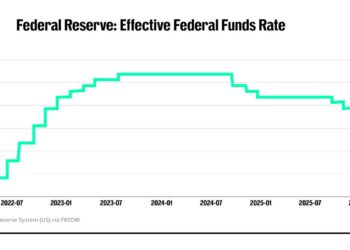
The FOMC kept its target rate at 3.5% to 3.75% in June. Its official statement noted inflation remained high relative to the central bank’s 2% target.
More AI:
- The new Chinese AI model rattling U.S. tech investors
- Anthropic restores access to Mythos 5 for select organizations
- SoftBank CEO offers stinging critique of Musk’s AI bet
The unseen danger is that the AI investment itself could hamper the ability to achieve rate decreases.
Federal Reserve Chairman Kevin Warshtold Congress on July 14 that expenditure on high-tech companies climbed roughly 25% in the year ended in the first quarter. Much of the growth was due to data-center building and demand for AI hardware and software, he said.
The Fed’s June meeting minutes were more explicit.
Some authorities argued heavy investment in AI could add to stubborn inflation if economic growth outpaces the economy’s ability to produce. They also suggested productivity increases from AI might eventually cut costs, although such benefits may take time to materialize.
That tension is significant for tech valuations.
The AI businesses are getting the benefit of phenomenal capital spending. But growth companies are equally vulnerable to interest rates because a lot of their price is based on earnings investors expect them to make in future years.
Higher yields diminish the present value of those future earnings. They also could raise the cost of funding for data centers, energy projects, and smaller enterprises trying to cash in on the AI build-out.
That creates a market where good economic news doesn’t always translate into excellent stock-market news.
Quick investment in artificial intelligence can boost revenues, spur demand for semiconductors, and drive economic growth. If that also pushes rate cuts further off, then investors might be less inclined to pay premium multiples for such earnings.
What investors should watch instead of bubble talk
The phrase “bubble” makes investors see the market as one trade.
No, it isn’t.
The S&P 500 is made up of 500 of the leading corporations and comprises around 80% of the available U.S. market capitalization. The index weights companies by market size; thus, the success of its largest constituents can still have a big impact on overall performance.
That causes a big difference between the index and the experience of the average stock.
The S&P Dow Jones Indices’ June factor report showed the equal-weighted S&P 500 behind the capitalization-weighted index over the prior one-, three-, five-, 10-, and 15-year periods. That means the largest companies have carried a disproportionate amount of long-term index returns.
For retail investors, that concentration is more valuable to watch than a broad bubble label.
There can be many extremely speculative equities in a market, but not all big companies are dangerously valued. It can also look solid at the index level even if fewer companies are responsible for its advances.
Key takeaways for AI investors
- Major AI suppliers are generating substantial revenue and earnings, unlike many dot-com-era companies.
- The S&P 500’s valuation remains above its recent historical averages, even if it is below the dot-com peak.
- Cooling inflation reduces the immediate risk of aggressive rate increases, but inflation remains above the Fed’s goal.
- AI investment is supporting economic growth and corporate profits.
- That same spending could keep inflation and interest rates higher than investors expect.
- Earnings growth, market breadth and interest-rate expectations matter more than whether commentators use the word “bubble.”
First, investors want to see if earnings will continue to underpin the price of the market.
Nvidia and Micron have posted amazing growth, but the higher the performance, the higher the expectations. A corporation can have another record quarter and still disappoint if investors are looking for something more.
The second measure is if earnings growth is widening.
JPMorgan, Goldman Sachs and Bank of America posted strong results that illustrate the market’s earnings story isn’t limited to technology. If financials, industrials and consumer sectors remain strong, the rise would be more sustainable.
The monetary policy is the final exam.
The Fed has “zero tolerance” for rising inflation, Warsh said in his congressional testimony, and remains committed to price stability. The central bank may be cheering productivity gains from AI but is unlikely to cut rates just to protect lofty stock prices.
Cramer is correct that a few speculative stocks don’t make a whole market another dot-com bubble.
But investors should not take that conclusion as a signal to buy.
The bigger threat is that the best businesses in the market will have to keep generating fabulous earnings as the AI boom stretches the economy’s ability and the Fed’s willingness to cope.
The rally doesn’t need to go to 2000 to be damaging.
All it needs is for profits to slow, or interest rates to stay higher for longer than the market expects.
Related: Jim Cramer crowns one surging sector the hottest in the market