The most dangerous moment for a stock is rarely when the skeptics pile on. It is when the last true believer quietly heads for the door.
Wall Street runs on a simple hierarchy. There are the analysts who never liked a company, the ones who flip with the wind, and the rare few who plant a flag and defend it through every rough quarter. That last group carries real weight, because when a stock stumbles, investors want to know whether the people who studied it most closely still buy the story. A skeptic turning bearish is noise. A champion walking away is a signal.
For most of 2026, International Business Machines (IBM) had exactly that kind of champion in its corner, an analyst who kept telling clients the bears had the math wrong. Then IBM posted the worst trading day in its history, and by the next morning, that champion, Oppenheimer, had folded.
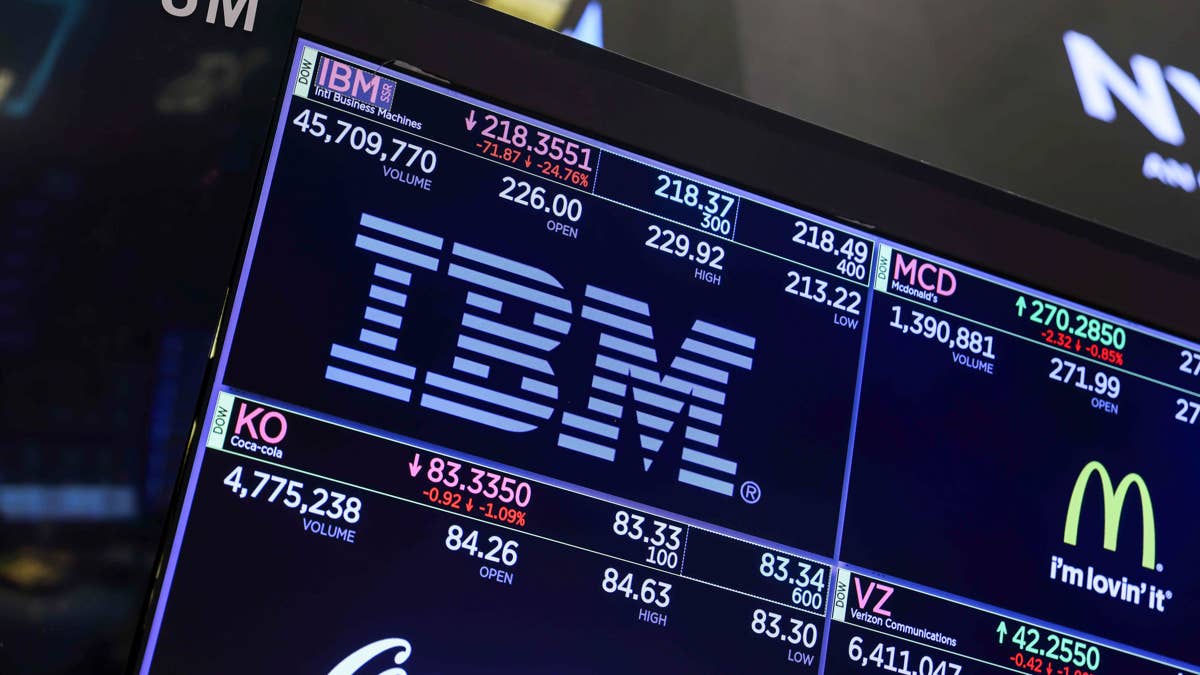
On July 14, IBM stock cratered 25.21% to close at $217.07, erasing roughly $68 billion in market value in a single session. A day later, Oppenheimer stripped away the bullish rating and price target it had defended all year, according to CNBC.
Why IBM stock cratered on July 14
IBM did not wait for its scheduled earnings date to break the news. Eight days before its July 22 conference call, chief executive Arvind Krishna sent investors an unscheduled letter warning that the second quarter had gone badly. “What played out was worse than our expectations,” Krishna wrote of the disappointing period, according to Forbes.
The numbers explained the panic only partly. Preliminary second-quarter revenue landed at $17.2 billion, roughly $660 million under the $17.85 billion analysts expected, according to Seeking Alpha. Operating earnings per share (EPS) came in at $2.93, missing the $3.01 estimate by eight cents.
More Wall Street:
- Wall Street’s $200 billion IPO wave threatens sell-off
- J.P. Morgan unleashes $50 billion buyback after stress test
- Bessent doubles down on Main Street over Wall Street
A 3.7% revenue miss does not usually erase a quarter of a company’s value. This one did. The close marked IBM’s steepest single-day drop on record, undercutting even the 23.7% collapse it logged on Black Monday in October 1987.
Krishna pointed to two problems. Several large deals slipped past the end of the quarter rather than closing, and in late June, clients abruptly redirected budgets toward artificial intelligence (AI) hardware, buying servers, storage, and memory instead of the software and mainframe products that carry IBM’s fatter margins.
There was also a mainframe hangover. IBM was lapping the launch of its z17 system, and the Transaction Processing software tied to that cycle came in soft, deepening the miss.
That middle problem is the one that should worry shareholders. A deal that slips can close next quarter. A structural change in how companies spend does not reverse on a schedule.
Related: IBM’s latest Wall Street call hides bigger shift
Oppenheimer walked back its biggest IBM call
Here is where my analysis kept snagging. For most of the year, Oppenheimer analyst Param Singh had been IBM’s loudest defender on the Street, arguing its software pivot was underappreciated and that bearish revenue estimates were simply too low.
As recently as this spring, he was telling clients the bears had IBM’s math wrong, according to Barron’s. When I lined those earlier notes up against the one Oppenheimer published this week, the reversal was hard to miss.
That kind of about-face rarely happens in isolation, and the wider tape has been jumpy about exactly this question of whether AI spending helps or hollows out the old guard.
Oppenheimer downgraded IBM to perform from outperform and dropped the price target it had carried all year, according to CNBC. The bank warned that the shortfall could threaten IBM’s full-year financial goals, a slip that could drive shares lower still.
Singh’s reasoning centered on software, the exact engine his bull case had run on. Software revenue grew just 5% in the quarter, well below the 12% Oppenheimer had modeled, according to Investing.com. Without large acquisitions or a wave of delayed deals finally closing, the firm now doubts IBM can reach double-digit software growth in 2026 or 2027. Singh told clients the stock would likely stay “range-bound near term.”
The rest of Wall Street split hard, which is the tell that this is a story about confidence, not just one weak quarter.
- HSBC cut IBM to reduce and slashed its target to $191, arguing investors could replicate IBM’s exposure more cheaply by buying a basket of its rivals, according to Investing.com.
- Morgan Stanley moved the other way, lifting its target to $293 from $267 while holding an equal weight rating, according to TheStreet.
- Oppenheimer landed in between, neutral rather than negative, scrapping its $350 target while still flagging bright spots like Red Hat and HashiCorp, according to CNBC.
When the bulls, the bears, and the fence-sitters cannot agree on what a 25% crash means, the market has not finished pricing the news.
What IBM has to prove on July 22
For everyday investors, IBM has long worn the costume of a safe stock. It is a century-old blue chip that has raised its dividend for 30 straight years, the kind of name that anchors retirement accounts precisely because it is supposed to be boring. A one-day crash of this size punctures that reputation, and it does so for a lot of people who never think of themselves as tech speculators.
That is the real stake here. This was not a meme stock or an unprofitable startup. It was a holding millions of ordinary savers treat as ballast, and on July 14 that ballast dropped a quarter of its value before lunch.
The July 22 earnings call now has to answer one question. Were those slipped deals merely late, or were they lost? If Krishna can show the revenue landing in the third quarter and reaffirm full-year guidance, July 14’s crash looks like an overreaction to a timing hiccup. If he cannot, the budget shift toward AI hardware starts to look less like a quarter and more like a trend, one that squeezes every legacy software vendor selling into the same shrinking IT budgets.
I have watched enough of these pre-announcements to know they rarely resolve cleanly in a week. The stock that just had the worst day of its life will spend the next several sessions trading on a single guess: whether the most patient bull on Wall Street gave up one quarter too early, or right on time.
Related: Jim Cramer shares strong verdict on IBM stock for investors