Threats have a shelf life.
Say you will do something by Friday, and Friday comes and goes without you doing it, and the people you were trying to frighten stop being frightened. They start doing arithmetic instead. They work out how much time they actually have, what the real cost would be, and whether you were ever going to follow through in the first place.
That is true in a schoolyard. It is true in a labor negotiation, and in a divorce, and in every situation where one side has more power than the other and both sides know the clock is the only thing that really matters.
It is also true in the plumbing of the global financial system, where the sharpest weapon the United States owns is not a carrier group. It is a phone call telling a foreign bank it can no longer touch American dollars. No shots, no headlines, just an account that stops working on a Tuesday morning.
For six months that weapon has been pointed at Tehran, and the volume has kept rising. The war passed its half-year mark. Military strikes gave way to financial ones. Treasury Secretary Scott Bessent stood in his department’s Cash Room on Aug. 24 and launched a campaign the administration branded an economic D-Day, saying he expected a major financial institution to be cut off by the end of that week.
The week ended. The major financial institution did not arrive. What arrived was a proposed rule aimed at the Emirati branches of an Egyptian lender, which is a considerably smaller thing.
On Sunday, Aug. 30, Bessent said the real one is coming this week, and he described the campaign in words no Treasury secretary reaches for lightly.
“This is going to be financial violence if we have to,” Bessent said in an interview with the Associated Press. “We are showing people that we know who you are, you know who you are, and this has got to stop.”
He did not name the bank.
Why the dollar system is Washington’s sharpest Iran weapon
Sanctions on Iran are not new. They are among the most heavily layered regimes on earth, and Tehran has spent decades building ways around them. What changed in 2026 is not the existence of pressure but where Washington is applying it.
More Economic Analysis:
- Is Trump’s big, splashy Venezuela oil deal real?
- Scott Bessent has surprising answer for U.S. debt fears
- Morgan Stanley has good news despite the yields and bad debt data
The target now is correspondent banking, the least glamorous and most important part of international finance. A bank in Dubai or Shanghai cannot settle dollar payments on its own. It needs an account at a U.S. institution to clear them. Take that account away and the bank still exists, but it can no longer move the currency most of the world’s oil is priced in.
That is the pressure point, and it is why oil sits underneath all of this. China has historically bought roughly 90% of Iran’s exported crude, which makes Chinese banks the load-bearing wall of the entire evasion network. Sanction one of them and you are not sanctioning Iran. You are sanctioning the second-largest economy in the world.
Related: Why Bessent’s Iran strategy looks like a work in progress
The waterway carrying the oil remains the wild card. Roughly six million to eight million barrels a day are still moving through the Strait of Hormuz despite the absence of any peace agreement, according to Trading Economics, well below what the passage normally handles.
I covered the launch of this campaign the week it happened, and the thing I flagged then still holds. Washington is not trying to make oil expensive. It is trying to make Iran poor without making oil expensive, and those two goals fight each other constantly.
What Bessent actually said about the next bank sanction
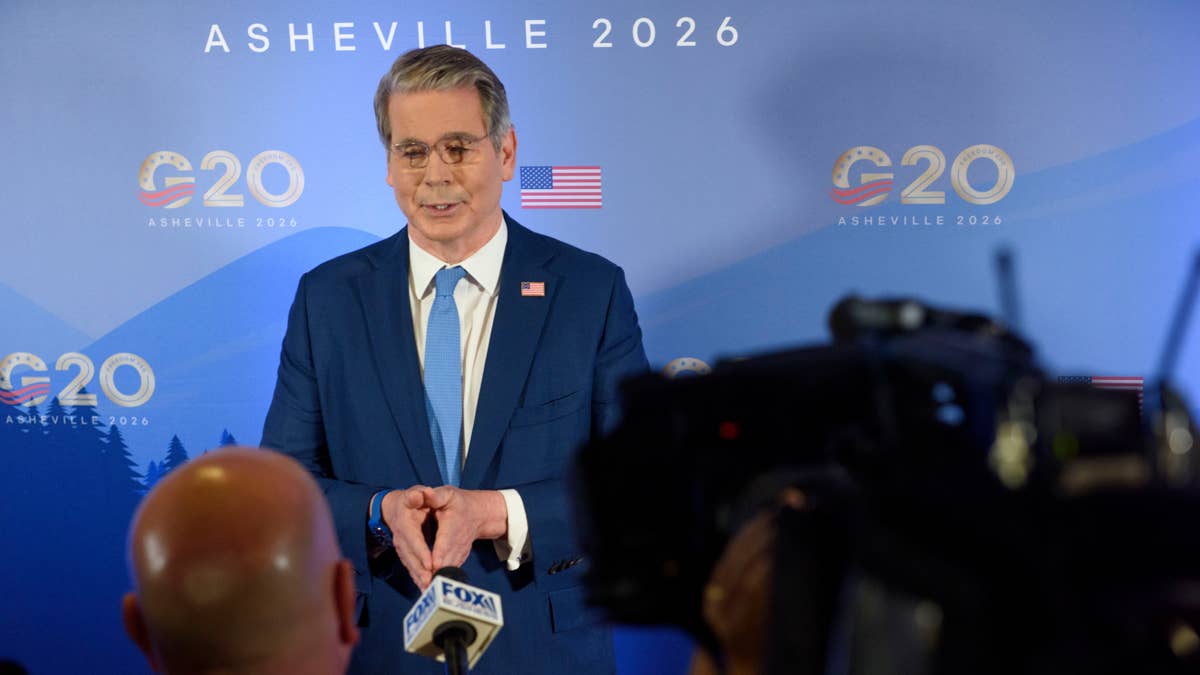
Bessent spoke to the AP ahead of Group of 20 meetings in Asheville, North Carolina, where he will meet one on one with counterparts from the world’s major and developing economies to push for cooperation against Iran. He said he would raise Iranian oil purchases directly with his Chinese counterparts, and that “all options are on the table” in terms of sanctioning Beijing, according to the Associated Press.
He also pushed back on the idea that the administration has been reluctant to confront China, calling that “a completely false narrative that the media picked up on.”
Here is where the gap between the language and the mechanism gets interesting. I pulled the actual filing Treasury put out on Friday, Aug. 28, and it is not a sanction. It is a notice of proposed rulemaking under Section 311 of the USA PATRIOT Act, finding the five United Arab Emirates branches of Banque Misr to be of primary money laundering concern.
The details are worth reading closely:
- Those branches processed approximately $1.8 billion for 103 companies potentially tied to Iranian shadow banking networks between January 2024 and June 2026, according to the Treasury Department.
- Roughly $520 million of that total fell within the most recent 12 months, per the FinCEN notice of proposed rulemaking.
- The rule carries a 30-day public comment period before it can take effect, the Treasury Department said, as reported by the Associated Press.
- The measure applies only to the bank’s UAE branches and only to its dollar transfers, according to a Central Bank of Egypt statement reported by PBS NewsHour.
The sequencing tells you something. A Section 311 rulemaking is slower and more procedural than a designation from the Office of Foreign Assets Control. It goes out for comment. It gets negotiated. Two central banks, Egypt’s and the UAE’s, were coordinating a response within days.
My read is that Treasury picked a target it could afford to hit. Banque Misr is Egypt’s second-largest bank, and Egypt is not going to retaliate against the United States. The banks clearing Iranian oil money at scale sit in a country that can.
What the Iran sanctions fight means at your gas pump
None of this stays abstract, because the transmission line runs straight to the pump.
Oil climbed Monday, Aug. 31, after U.S. forces struck Iranian rocket launchers on the Strait of Hormuz over the weekend, the first American military action there in weeks. Brent rose to about $90.69 a barrel and West Texas Intermediate to roughly $85.54, gains near 3% on the day, according to Trading Economics.
Drivers are already carrying the earlier moves. The national average for a gallon of regular sat at $4.08 on Aug. 31, and the average stayed above $4 every single day of August for the first time on record, according to AAA, making it the most expensive August at the pump the country has ever had.
That is the part of this story that shows up in your budget rather than your news feed. A campaign designed to strangle Iranian revenue also squeezes the supply route, and the risk premium lands on American households before it lands on Tehran.
The next few days will tell you which version of this campaign Washington is actually running. If the bank Bessent sanctions this week is another regional lender in a friendly jurisdiction, the message to Tehran is that the dollar system has limits it will not cross. If it is Chinese, the calculation changes for every commodity desk and every driver in the country, and the arithmetic Iran has been doing since Friday stops working.