
IonQ did not lose $1.9 billion last quarter. It earned record revenue, raised guidance, closed a $1.8 billion acquisition — and then booked a $1.6 billion non-cash charge because its own share price went up. That single accounting mechanic is the most misunderstood thing about IonQ (NYSE: IONQ) right now, and it explains why the headline “record quarterly loss” and the headline “record quarterly revenue” describe the same three months.
Here is the tell, and it is verifiable from IonQ’s own filings. In Q1 2026, IONQ shares fell from $44.87 to $28.83 — a 35.7% decline — and IonQ reported net income of $805.4 million. In Q2 2026, the shares rose from $28.83 to $53.26 — up 84.7% — and IonQ reported a net loss of $1.87 billion. The company’s warrant liability is, in effect, a short position on its own stock. When IONQ rallies, IonQ’s income statement bleeds. Any price target built off GAAP earnings is measuring the share price, not the business.
With the stock at $46.84 (17 August 2026 close), this piece sets out a $82 bull case and a $26 bear case, both anchored to the post-SkyWater balance sheet rather than to the sell-side’s revenue-multiple guesswork.
Quick Take: the numbers that matter
- Spot: $46.84 (17 Aug 2026 close). 52-week closing range $26.59 to $82.09 — StockAnalysis
- Q2 2026 revenue: $80.05m, +287% YoY, beating consensus of $66.4m — IonQ 10-Q, 10 Aug 2026
- Warrant fair-value charge, Q2 2026: $1,649.1m. Q1 2026 was a gain of $1,057.6m — IonQ 10-Q
- Derivative liability at 30 Jun 2026: $3,052.4m — 88.8% of IonQ’s $3,439.0m total liabilities, and larger than its entire cash pile
- Cash and investments: $2,959.3m at 30 Jun 2026; $2.0bn pro-forma after funding SkyWater — IonQ Q2 call
- Remaining performance obligations: $485m, up from $122m a year earlier — IonQ Q2 call
- Street consensus target: $70.83 across 12 analysts as of 13 Aug 2026; Jefferies $75 (cut from $85), Morgan Stanley $49
- Realised volatility: 99.1% annualised over the last 90 sessions — FinanceFeeds calculation on daily closes
The warrant trap: why IonQ’s loss grows when the stock works
Start with the line item almost no coverage mentions. At 30 June 2026, IonQ carried a non-current derivative liability of $3.05 billion. Total liabilities were $3.44 billion. That one liability is 88.8% of everything IonQ owes, and it exceeds the company’s $2.96 billion of cash and investments.
It is a warrant liability, marked to market every quarter. As IONQ’s share price rises, the warrants become more valuable to their holders and more expensive to IonQ, and the difference runs straight through the income statement as a non-cash charge. IonQ’s own earnings-call summary says so plainly: the Q2 2026 call attributes the “$1.9 billion GAAP net loss” to “a $1.6 billion non-cash impact from the mark-to-market valuation of warrants as required by accounting conventions.”
Run the correlation across two quarters and it is close to mechanical:
| Quarter | IONQ share move | Warrant fair-value line | GAAP net result | Operating loss |
|---|---|---|---|---|
| Q1 2026 | $44.87 → $28.83 (−35.7%) | +$1,057.6m gain | +$805.4m profit | −$271.5m |
| Q2 2026 | $28.83 → $53.26 (+84.7%) | −$1,649.1m charge | −$1,867.7m loss | −$337.2m |
The operating loss — the part that reflects the actual business — barely moved, from $271.5 million to $337.2 million. The bottom line swung by $2.67 billion. Having covered several de-SPAC balance sheets carrying this structure, the pattern is always the same: the market reads the net-loss headline, the shorts quote it, and the number is an artefact of the share price rather than a signal about it.
The practical consequence for anyone modelling IONQ: use adjusted EBITDA (−$120.3 million in Q2) or operating loss, and treat the derivative line as noise. It also means the reverse trap is loaded. If IONQ falls to the $26 bear case, IonQ will very likely report a large GAAP profit in that quarter. Do not mistake it for a turnaround.
What IonQ actually bought, and what it does to the revenue mix
On 31 July 2026 IonQ closed its $1.8 billion acquisition of SkyWater Technology, paying SkyWater holders $15.00 in cash plus 0.4883 IonQ shares each. On roughly 49.4 million SkyWater shares that is about $741 million of cash and roughly 24.1 million new IonQ shares, taking the count from 381.0 million (29 July) to approximately 405.1 million.
Now the part the guidance hides. IonQ’s raised full-year outlook of $280–290 million excludes SkyWater entirely. Yet SkyWater’s own filings show H1 2026 revenue of $317.1 million — more than double IonQ’s own H1 revenue of $144.7 million. Annualise it and SkyWater runs at roughly $634 million against IonQ’s ~$285 million.
Net of the roughly $120 million of intercompany spending management said will be eliminated on consolidation, the combined group runs at approximately $800 million. So the majority of the new IonQ’s revenue is a contract semiconductor foundry — and SkyWater’s H1 gross margin was 21.2% ($67.4 million gross profit on $317.1 million), against a modest H1 net loss of $18.7 million.
This is the mix shift nobody is pricing. Every “IONQ trades at X times sales” calculation circulating right now uses the $285 million standalone number and ignores two-thirds of the revenue. On the correct base, IonQ’s ~$19.0 billion market cap and ~$17.0 billion enterprise value work out to about 21× EV/sales, not the 65× the standalone math implies. That is the single most bullish fact in this entire analysis — and it comes with the catch that the revenue doing the deflating carries foundry economics, not software economics.
The engineering rationale is real, though. IonQ is shifting from laser-based to electronic qubit control precisely so its qubits can be fabricated on a standard semiconductor process, and it reported 99.99% two-qubit gate fidelity using that approach. CEO Niccolo de Masi framed the first chips as proof the vertical stack works: “IonQ and SkyWater have together carried a design from concept to fabrication.” Commissioning of the 256-qubit system is planned for 2027. Compare the manufacturing posture with the superconducting route we covered in our Rigetti RGTI bull and bear analysis, where fabrication remains outsourced.
The regulatory fight IonQ won — and why the FTC chairman said so publicly
This deal cleared, but the paper trail is extraordinary and it is a live risk factor almost nobody has read.
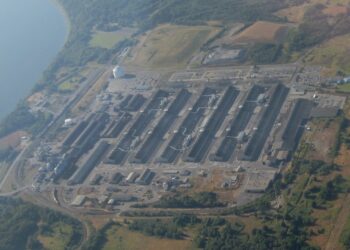
SkyWater is the largest exclusively US-based semiconductor foundry and it fabricates chips for several of IonQ’s direct competitors. The FTC’s own staff spent months negotiating a behavioural remedy that would have kept SkyWater’s foundries open to rivals and walled off competitors’ technical information under an outside monitor. That remedy never happened, and the Commission granted early termination on 28 July 2026.
What makes this unusual is that FTC Chairman Andrew N. Ferguson publicly recorded his dissent from his own agency’s outcome. In his 31 July 2026 statement in Matter No. 2610061, Ferguson wrote: “I did not prefer this outcome. But this agency is a multi-member Commission, and reasonable minds differed on the facts that staff’s investigation uncovered, and what to do about them.” He went further, stating that the investigation “gave me the required ‘reason to believe’ that the effect of this vertical merger ‘may be substantially to lessen competition’ in the short term, while likely providing benefits to competition and innovation in the long run.”
Commissioner Mark R. Meador, who declined to support the restrictions, set out the opposing view in a parallel statement: “My own conclusion is that the evidence available is insufficient to demonstrate that the effect of the transaction may be to substantially lessen competition, and on the contrary suggests that the transaction would be procompetitive or competitively neutral in its effects.” Meador also noted the foreclosure concern was “limited solely to SkyWater’s own existing customer base, which SkyWater reported as eight customers at the end of 2025.”
Per Semafor’s reporting, Pentagon officials had run a pressure campaign against the deal, worried IonQ would box out rival quantum firms in which the US government holds direct stakes. They lost.
Investors on r/IonQ read the implication immediately, with one top comment capturing it exactly: “From a regulatory standpoint probably not a great thing, but from a shareholder perspective I’m thrilled.”
They are right on both counts, and that is the tension. IonQ now owns a chokepoint its competitors need, with no consent decree governing how it behaves. The upside is obvious. The risk is that behavioural conditions rejected in 2026 are exactly the kind of thing a differently-composed Commission revisits — and a chairman’s written “reason to believe” is a durable document. This is a materially different regulatory posture from the compliance-driven stories in our coverage of SEALSQ and the quantum-security cohort.
Market data: what the tape and the backlog are saying
Two things stand out on the tape. First, the earnings reaction was not what the beat implied: IONQ fell 4.29% on 5 August, the day of the release, then ripped 11.86% on 7 August on 31.1 million shares — the heaviest volume of the month. The market needed two sessions to work out that a 287% revenue beat mattered more than a $1.9 billion accounting loss. That lag is itself evidence of how badly the warrant line distorts the first read.
Second, the backlog. Remaining performance obligations reached $485 million, up from $122 million a year earlier — a 297% increase, and a figure that now exceeds the entire standalone full-year guidance. RPO is signed, contracted, unrecognised revenue. It is the least manipulable number IonQ publishes, and it is growing faster than reported revenue. Combine that with 60% commercial revenue and 50% international, and the “government science-project” characterisation of IonQ is out of date.
Now the synthesis that neither figure states alone. IonQ spent $160.6 million on R&D in Q2 against $80.05 million of revenue — it is spending two dollars on research for every dollar it books. Adjusted EBITDA was −$120.3 million. Against $2.0 billion of pro-forma cash, that is roughly four years of runway at the current burn. IonQ does not have a liquidity problem, which removes the argument that sank the smaller quantum names — the cash-floor logic we applied in our QUBT price prediction simply does not bind here. What IonQ has instead is a dilution problem: shares went from 362.6 million at 31 December to roughly 405.1 million post-SkyWater, up 11.7% in seven months.
Context from the sector matters too. D-Wave posted just $3.01 million of quarterly revenue with bookings of $2.1 million in the same period, as we detailed in our D-Wave Q2 breakdown and our QBTS bull and bear case. IonQ booked more revenue in Q2 than D-Wave has in its entire history. Within pure-play quantum, this is not a peer group — it is IonQ and everyone else.
The $82 bull case
Target: $82 — a 75% gain from $46.84.
The bull case is not a new-highs fantasy; it is a return to the 13 October 2025 closing high of $82.09. What makes it interesting is what has changed underneath that identical price.
At the October peak, IonQ was worth roughly $29 billion on a revenue run-rate of about $130 million — call it 220× sales. At $82 today, on 405.1 million shares, the market cap is $33.2 billion against roughly $800 million of pro-forma combined revenue: about 39× EV/sales. The stock can round-trip to its old high while its valuation multiple falls by more than 80%. That is the asymmetry the bulls actually own.
The path requires three things, in order. SkyWater must keep its merchant customers rather than losing them to the conflict-of-interest problem the FTC chairman flagged — watch renewals over the next two quarters. IonQ’s organic growth must hold above 100% (it ran +132% in Q2), which the $485 million RPO makes credible into 2027. And the electronic-qubit-control transition must stay on schedule for 2027 commissioning; the 99.99% two-qubit fidelity result is the strongest evidence so far that it will. Jefferies’ $75 target sits just below this scenario, and the $100 street high sits above it.
The $26 bear case
Target: $26 — a 44% decline from $46.84.
The bear case is not bankruptcy. With $2.0 billion of pro-forma cash it cannot be. It is a multiple re-rating toward what IonQ’s revenue mix now actually looks like.
$26 puts the market cap at $10.5 billion, an enterprise value near $8.5 billion, and about 10.6× EV/sales on the $800 million base. Note that even the bear case is not a value price — that is precisely the point. It is a retest of the 30 March 2026 closing low of $26.59, a level this stock traded at five months ago, and the drawdown from October 2025 to March 2026 was 68%. A stock with 99% annualised realised volatility can do that again without anything breaking.
The triggers: the majority of combined revenue is a 21%-gross-margin foundry, and if the market starts valuing the group on blended margins rather than quantum optionality, the multiple compresses hard. The 256-qubit commissioning date is in 2027, meaning 2026 revenue is subsystems, cloud access and contract fabrication — not fault-tolerant quantum computing. Dilution continues at double digits annually. And Morgan Stanley’s $49 equal-weight target — barely above spot — is the sell-side’s own quiet admission that the risk here is two-sided. As COO and CFO Inder Singh told the Q2 call: “We recognize, as with any company, execution is always key, and there are always risks that we must work to mitigate.”
Scenario table
| Scenario | Price | vs spot $46.84 | Market cap | EV/sales on ~$800m | Requires |
|---|---|---|---|---|---|
| Bull | $82 | +75% | $33.2bn | ~39× | SkyWater merchant base retained; organic growth >100%; 2027 commissioning on track |
| Street | $70.83 | +51% | $28.7bn | ~33× | Consensus of 12 analysts, 13 Aug 2026 |
| Bear | $26 | −44% | $10.5bn | ~10.6× | Blended-margin re-rating; 2027 milestone slips; sector drawdown repeats |
What happens next
First, combined guidance is the next real catalyst. Management said integration work is underway to “establish combined financial guidance for the unified entity.” When that lands — most likely with Q3 results in November 2026 — the market will see the ~$800 million consolidated number for the first time. Expect the reflexive reaction to be bearish on the optics of a diluted gross margin, and expect that to be the wrong read: the same disclosure cuts the sales multiple by roughly two-thirds.
Second, watch SkyWater’s merchant renewals, not IonQ’s press releases. Meador’s statement pinned the entire competitive question on eight named customers. If two or more migrate away from SkyWater over the next twelve months, the vertical-integration thesis loses its ecosystem leg and IonQ is left owning a subscale fab. If they renew, Ferguson’s short-term foreclosure concern turns out to have been the bull case in disguise.
Third, expect a GAAP “profit” that means nothing. If IONQ trades down toward the bear case in any quarter, the warrant liability unwinds and IonQ will report net income running to hundreds of millions or more. Some outlets will call it a turn to profitability. It will be the opposite — the accounting equivalent of a falling share price. Anyone who has followed the mark-to-market distortions in our Arm bull and bear analysis will recognise the pattern.
The base case, on balance, sits closer to the Street’s $70.83 than to either extreme. IonQ is the only pure-play quantum company with material revenue, a four-year cash runway, a Pentagon-accredited domestic foundry and a backlog growing at 297%. It is also carrying a $3.05 billion derivative liability, spending two dollars of R&D per dollar of revenue, and asking investors to fund an 18-month wait for its flagship system. Both of those descriptions are true, which is exactly why the distribution is this wide.
Frequently asked questions
What is the IonQ stock prediction for 2026?
Our scenarios put IonQ at $82 in the bull case and $26 in the bear case, against a spot price of $46.84 on 17 August 2026. Wall Street’s consensus target is $70.83 across 12 analysts as of 13 August 2026, with Jefferies at $75 and Morgan Stanley at $49. The wide range reflects 99% annualised realised volatility, not analyst disagreement about the business.
Why did IonQ report a $1.9 billion loss if revenue grew 287%?
Roughly $1.6 billion of that loss was a non-cash mark-to-market charge on IonQ’s warrant liability, which rises in value when IONQ shares rise. IonQ’s operating loss was $337.2 million and adjusted EBITDA was −$120.3 million. In Q1 2026, when the stock fell 35.7%, the same mechanic produced a reported net profit of $805.4 million.
How does the SkyWater acquisition change IonQ’s valuation?
Substantially, and in IonQ’s favour on a multiples basis. IonQ’s $280–290 million guidance excludes SkyWater, which ran $317.1 million of revenue in H1 2026 alone. Net of about $120 million in intercompany eliminations, the combined group runs near $800 million — putting IonQ at roughly 21× EV/sales rather than the 65× the standalone figure implies. The trade-off is that SkyWater’s gross margin is 21.2%.
Does IonQ have enough cash to reach profitability?
IonQ held $2.96 billion in cash and investments at 30 June 2026 and roughly $2.0 billion pro-forma after funding the SkyWater deal. Against adjusted EBITDA burn of about $120 million per quarter, that is close to four years of runway. Liquidity is not the near-term risk; dilution is, with the share count up 11.7% in seven months.
Is IonQ a better buy than Rigetti or D-Wave?
On revenue scale it is not close — IonQ booked $80.05 million in Q2 2026 against D-Wave’s $3.01 million. IonQ is also the only one of the three that owns its fabrication. Whether that justifies the multiple gap is a separate question, and the smaller names carry higher beta in both directions.
What is the biggest risk to the IonQ bull case?
SkyWater’s merchant customers leaving. FTC Commissioner Mark Meador’s statement narrowed the entire competitive question to SkyWater’s eight existing customers. If rival quantum firms move fabrication elsewhere rather than buy from a competitor, IonQ ends up owning a subscale fab instead of an industry chokepoint — and the vertical-integration premium disappears.
This article is for information purposes and does not constitute investment advice. Price data as of the 17 August 2026 close. Financial figures are drawn from IonQ’s and SkyWater’s SEC filings and IonQ’s Q2 2026 earnings call.